Extrinsic Vertices are lattices and patterns developed from tilings of polygons. I create edge-to-edge tilings or tile patches, and then plot the extrinsic vertices of potential tiles, creating a lattice structure. From these lattices I germinate patterns. The pattern lines extend out from the vertices of tiles and potential tiles.
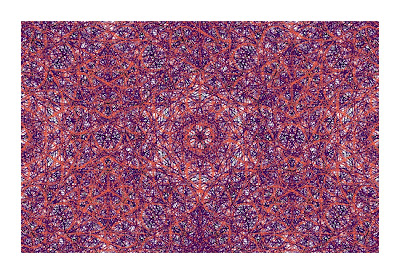
The processes, lattices, and patterns in this project are not math. I’m influenced by structures in math, science, architecture, and design, but unconstrained by the rigorousness of math. The patterns have no practical use or purpose beyond this project.
Extrinsic vertices and potential tiles are terms that describe objects unique to this project. They are elements I designed to create lattices and patterns, but are not recognized elsewhere. I begin with tile sets of two or more regular polygons, rectangles, isosceles triangles, isosceles trapezoids, or rhombuses. The selection and arrangement of tiles is not necessarily predetermined as in a periodic or symmetrical pattern. At any step in building a tiling I can make multiple selections from the tile set, each with potential vertices. The vertices of potential tiles are extrinsic to the tiling. These vertices lie in characteristic dot patterns or lattices depending on the angular properties of the tile set.
I almost always borrow from math a preference for edge-to-edge tilings, simple polygons, and filling the plane with no gaps or overlaps. In contrast to typically symmetrical tilings like those in Islamic architecture, I often opt to create nonperiodic tilings, to select asymmetry. Ultimately I obscure the tilings with overlapping patterns.
These designs begin with tile patches, not in fact tilings or tessellations. They are tile patches – a finite number of tiles from some tiling. All of them could be extended, and most if not all might fill the plane if extended. However, it’s not necessarily clear how they would be extended or what a tiling extending any patch might look like.
My tilings based on a pentagon tend to include polygons with angles that are multiples of 18 degrees. Those based on a hexagon tend to include polygons with angles that are multiples of 30 degrees. Tilings based on a square tend to include polygons with angles that are multiples of 45 degrees. Tile sets with just one of these three angle groups have vertices and extrinsic vertices that lie in characteristic patterns depending on the angles used. Other mixed tile sets have their own characteristic vertex lattices. As tilings become complex with mixed tile sets the lattices reveal new patterns characteristic of the tile set, often repeating rosettes.
For reference, I refer you to the dot patterns described in
Tilings and Patterns, by Grunbaum and Shephard (p. 238-246). Some of my simplest lattices correspond to
Bravais lattices in 2 dimensions. The more complex lattices are possibly overlain combinations of dot patterns or lattices. I emphasize that the images and techniques in this project are not math.
I advocate using complex technology to create art that mimics natural beauty. If you know the technology and use it assertively, resolutely, and creatively you can produce something new and interesting. If it’s a bit innovative it might also be instructive, at least for other interested artists. Maybe it opens a path with potential. You can work with the natural beauty of math, though no one is likely see it in your work. You can also mimic or parallel nature. I do this kind of art because I think I’m particularly good at it: connecting, organizing, coding, elaborating, extending systems, following narrow paths that haven’t been pursued.


 The processes, lattices, and patterns in this project are not math. I’m influenced by structures in math, science, architecture, and design, but unconstrained by the rigorousness of math. The patterns have no practical use or purpose beyond this project.

