Monday, December 29, 2014

Compound Fourier Series Surfaces


This gif demonstrates how combinations of Fourier series mathematical functions can be used to create complex animated surfaces like these: Fourier Series, & Rectify. Fourier series functions create certain periodic waves such as square, triangle, sawtooth, or semicircle waves from the sum of simple sine waves. In this example a Processing program uses combinations of sine waves and Fourier series functions to simulate a complex undulating surface.

Simple sine waves applied to the vertical
and horizontal axes were used to generate a static base form:
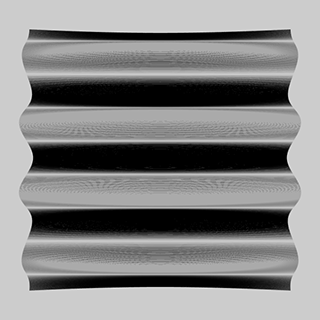


The forms are projected in perspective with the amplitude of a sine wave modulating the z axis depth in space. When the two are added together they make:


Fourier series triangle wave functions applied to the horizontal and vertical axes, and added together make:


Using a different frequency there are four times as many triangle waves as there were sine waves. Combining all four functions, two sine and two triangle Fourier series waves, makes:
   

Animating the composite form by moving the triangle waves across the static sine waves makes the final gif, top.

For simplification, two of the four functions that are combined in this example are just sine waves. The other two Fourier series functions are only a few sine functions, sufficient to create a suitable triangle wave.

This example, as well as each surface in Fourier Series, & Rectify could be used to model physical surfaces.

Saturday, December 27, 2014

& Rectify

& Rectify


The & Rectify gifs are based on waveforms similar to Fourier series mathematical functions. Programs written in Processing generate and animate surfaces using combinations of sine and cosine waves. Wave frequencies determine the number of forms within the frame. Wave amplitudes are applied to the z axis placing each pixel forward or back in space. The phase changes with each frame, moving some forms across the plane. The functions used are similar to a Fourier series in which sine and cosine functions are combined to approximate square, sawtooth, or triangle waves. In each of these examples the functions were modified to create new, irregular periodic forms. Multiple functions are applied to each frame. Some forms remain static while others move. Ultimately, functions are combined at the pixel level. In each case two gifs were created, with one using a rectified version of the static forms. These rectified versions are identical to their corresponding gifs except that pixels in negative z space are flipped to positive values.

Tuesday, December 9, 2014

Fourier Series

Fourier Series, 31

The Fourier Series are gifs based on waveforms similar to Fourier series mathematical functions. Programs written in Processing generate and animate surfaces using combinations of sine and cosine waves. A wave frequency determines the number of forms within the frame. The wave amplitude is applied to the z axis placing each pixel forward or back in space. The phase changes with each frame, moving forms across the plane. The functions used are similar to a Fourier series in which sine and cosine functions are combined to approximate square, sawtooth, or triangle waves. In each of these examples the functions were modified to create new, irregular periodic forms.

Friday, November 14, 2014

Facade


Facade and Facade 2 are gifs built with composite waveforms. Each of 62 programs written in Processing generates a gif using sine waves to animate images. The programs may calculate one or two waves for the horizontal and vertical axes (rows and columns of pixels). As in a sine wave, a frequency determines the number of waves within the frame. The phase changes with each frame, moving waves across the frame. The amplitude is applied to the z axis placing each pixel forward or back in space.

Overtones


http://www.joebartholomew.com/Overtones/overtones03.html

Overtones are gifs built with composite waveforms. Each of the 31 programs written in Processing generates a gif using slightly different wave formulas. In each case the program calculates two waves, one each for the horizontal and vertical axes (rows and columns of pixels). As in a sine wave, a frequency determines the number of waves within the frame. The phase changes with each frame, moving the waves generally from left to right. A complex form of a sine wave or similar waveform determines the amplitude.The amplitude is applied to the z axis, the x and y axes being fixed by the grid of pixels. An amplitude calculation is made for both the rows and the columns of pixels in the frame, and the two are added together to place each pixel forward or back in space.

Wednesday, May 15, 2013

Green 010


2D grids morphing in slow motion. A video in ten parts: Green 010.

Sunday, April 28, 2013

Transform


The Transform animations are eight short videos of 3D grids morphing in slow motion. Bitmap images are condensed into grids of cells. Each translucent, monochrome cell is moved forward or back based on its value. As one grid fades out another fades in: Transform


Tuesday, March 19, 2013

Oblique

Oblique is a series of experimental videos in 17 parts. View all of them here: Oblique


Oblique: Plot a curve. From points along the curve extend lines oblique to the plane of the curve. Make two or more such overlapping objects. Rotate.

Sunday, March 17, 2013

Parallel

Parallel is a series of experimental videos in 20 parts. View all of them here: Parallel.


Parallel: Plot a curve. From points along the curve extend lines perpendicular to the plane of the curve. Make two or more such overlapping objects. Rotate. Maintain parallel lines. In a few variations, extend lines to a second, smaller curve, as in a cone. View from a line of sight perpendicular to the plane of the curves.

Tuesday, December 18, 2012

Six Degrees of Freedom


Click here to see all seven videos.


Six Degrees of Freedom is a program that generates symmetrical patterns from perspective renderings of overlapping and rotating polyhedra. These wireframe forms, built and animated with code, endlessly rotate in shared digital space.

Six Degrees of Freedom was exhibited at the gallery, Chambers @ 916, November and December, 2012.

Thursday, March 15, 2012

Pentagonal Orthobirotunda Pattern

Girih patterns are decorative Islamic designs in which star shapes and polygons are connected with interlacing straight lines. Girih (Persian for “knot”) can be painstakingly created with a straightedge and compass. About nine hundred years ago Islamic architects developed an ingenious method for generating girih patterns simply with tiles. The girih tiles are five decorated polygons used to create girih patterns systematically without the need for complex drafting. We can extend the girih system into three dimensions by applying the concept to the faces of polyhedra.

Here are twelve pentagonal orthobirotundi, with girih patterns.


Thursday, February 9, 2012

Girih Icosidodecahedron and Pentagonal Orthobirotunda

These two girih polyhedra are a 32-faced icosidodecahedron and the related pentagonal orthobirotunda. They each include 12 pentagon and 20 triangle faces. The pentagons are decorated with the girih tile pattern. A similar pattern continues across the equilateral triangles.

Icosidodecahedron Wireframe Girih Pattern

Icosidodecahedron with Girih Pattern

Icosidodecahedron

Pentagonal Orthobirotunda Wireframe Girih Pattern

Pentagonal Orthobirotunda with Girih Pattern

Pentagonal Orthobirotunda

Monday, February 6, 2012

Chalice: Concave Girih Polyhedra with Decagons and Pentagons

These girih polyhedra have 32 faces. They include 2 decagon and 10 pentagon faces, as well as triangles. The decagon and pentagon are decorated with the girih tile pattern. A similar pattern continues across the triangles. The triangles are equilateral.

These polyhedra are related to an icosidodecahedron and pentagonal orthobirotunda. You can split an icosidodecahedron in half (making two pentagonal rotunda) and reattached the halves at pentagons to create the chalice.

Chalice Wireframe Girih Pattern

Saturday, February 4, 2012

Girih Polyhedra with Decagons and Elongated Hexagons

These girih polyhedra have 32 faces. They're related to the quasiregular polyhedron, the icosidodecahedron. They include 2 decagon and 10 elongated hexagon faces, as well as triangles. The decagon and elongated hexagon are decorated with the girih tile pattern. A similar pattern continues across the triangles.

 32 Faces with Girih Pattern

32 faces

 32 Faces with Wireframe Girih Pattern

Saturday, January 21, 2012

Girih Polyhedra with Bow Tie Hexagon

These girih polyhedra are heptakaidecahedrons, but they include bow tie concave hexagons where my first version had elongated hexagons, and the second version had rhombi. The pentagon and elongated hexagon are decorated with the girih tile pattern. A similar pattern continues across the triangles.

 Heptakaidecahedron with Girih Pattern

 Heptakaidecahedron

 Heptakaidecahedron Wireframe Girih Pattern

Thursday, January 19, 2012

Girih Polyhedra with Rhombus

These girih polyhedra are heptakaidecahedrons, but they include rhombi where my first version had elongated hexagons. The pentagon and rhombus are decorated with the girih tile pattern. A similar pattern continues across the triangles.

Heptakaidecahedron with Girih Pattern

Heptakaidecahedron

Heptakaidecahedron Wireframe Girih Pattern

Wednesday, January 18, 2012

Girih Polyhedra Pattern

This pattern is from twenty heptakaidecahedrons decorated with girih tile strapwork, and aligned side-by-side. The heptakaidecahedron is a seventeen sided, geometric solid with two girih tile pentagonal faces, five girih tile elongated hexagon faces, and ten isosceles triangles. In this pattern, the three dimensional solids are in five rows of four each heptakaidecahedrons with each alternating row rotated by 180 degrees, and viewed in perspective.

These are the same heptakaidecahedrons at a different scale, and rotating.

Saturday, January 14, 2012

Girih Polyhedra

These images are stills from an animation of rotating girih polyhedra. The two polyhedra shown here are a dodecahedron and a heptakaidecahedron. Both of these include faces that are from the girih tile set. The heptakaidecahedron is a seventeen sided geometric solid with two girih tile pentagonal faces, five girih tile elongated hexagon faces, and ten isosceles triangles. The triangles are not original girih tiles. The dodecahedron is a platonic solid, with twelve sides of regular pentagons. The girih tile faces can be decorated with girih lines to create a three dimensional girih pattern.

In one important sense applying girih patterns to polyhedra defeats the purpose of the girih pattern system. That is, girih tiles are designed so that the interior decoration lines continue across boundaries, tangentially. When the lines cross boundaries that are not in the same plane, the continuity is interrupted.

Dodecahedron with Girih Pattern

Dodecahedron

Dodecahedron Wireframe Girih Pattern

Heptakaidecahedron with Girih Pattern

Heptakaidecahedron

Heptakaidecahedron Wireframe Girih Pattern